Cutting Tool Basics【End Mills · Inserts · Drills — Types and Selection Explained】
Cutting tools greatly affect the quality, throughput and cost of machining. On the same machine, choosing the tool's shape, material and coating to match the workpiece changes the finish, tool life and cycle time. This guide covers tool types, tool materials, coatings and selection by workpiece — with a diagram.
Main cutting tools
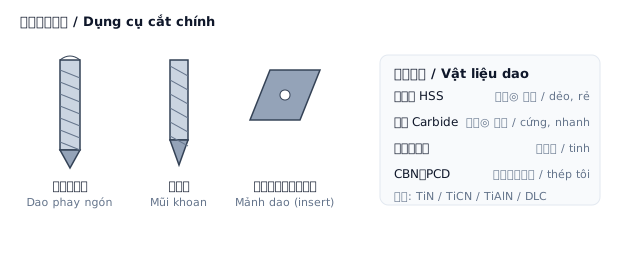
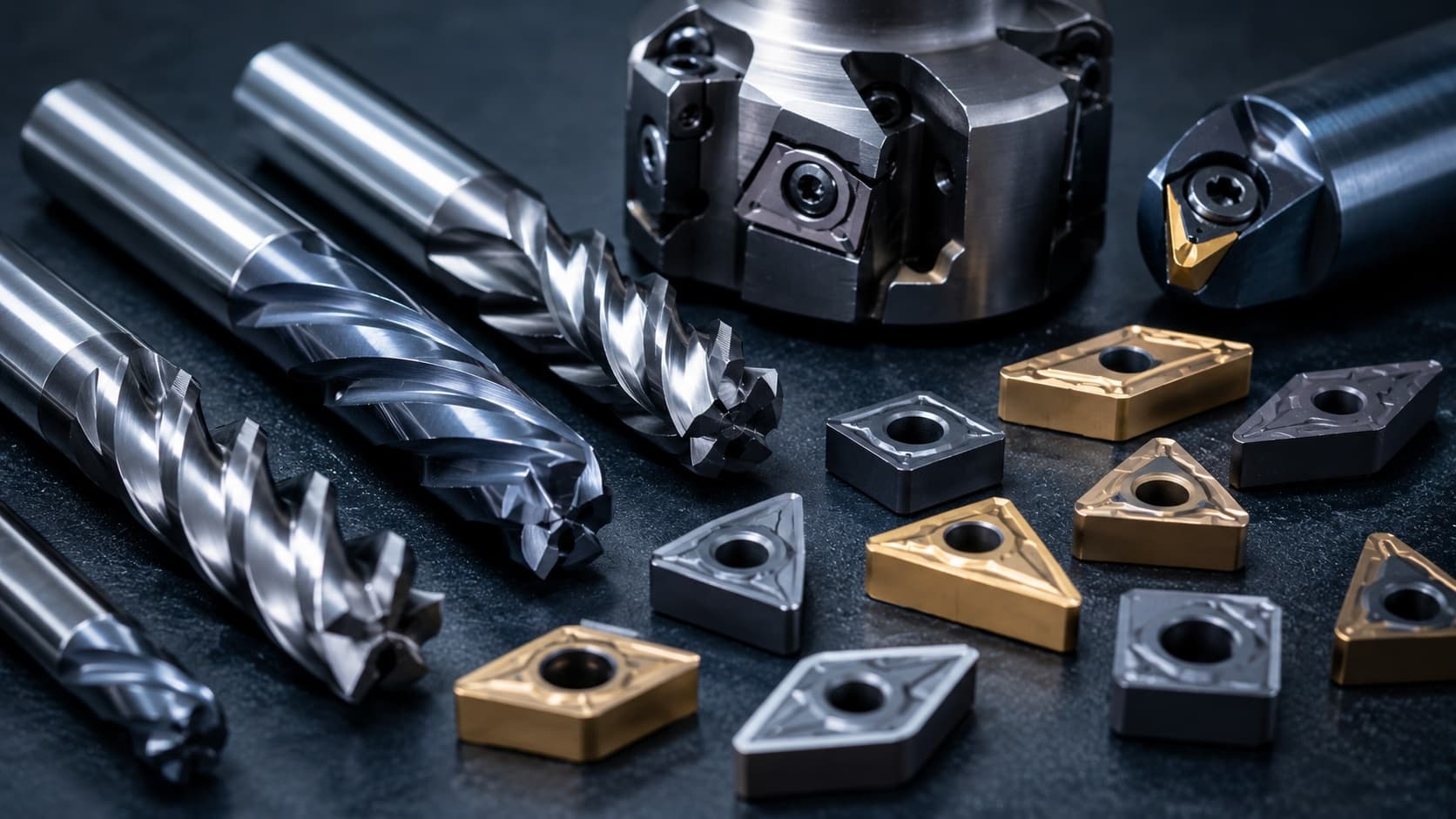
Fig. 1 — Representative tools. Milling uses end mills, hole-making uses drills, and turning uses indexable inserts.
End mill types
- Square: the basic for faces, walls and slots. Sharp corners.
- Ball: a spherical tip for curved surfaces and 3D work.
- Radius (bull-nose): a corner radius; chip-resistant and good for high feed.
- Flute count: 2 flutes give deep gullets and good evacuation (for aluminum); 4 flutes give rigidity and finish (for steel).
Tool materials (substrate)
| Material | Traits | Suited to |
|---|---|---|
| HSS (high-speed steel) | Tough ◎, cheap, re-grindable | Low speed, interrupted, general |
| Carbide | Hard ◎, strong at high speed | Volume, high throughput |
| Cermet | Fine finish ◎ | Finishing steel |
| CBN · PCD | Ultra-hard | Hardened steel, hard-to-cut, high-speed aluminum |
Coatings
Coatings add hardness, heat resistance and lubricity.
- TiN (gold): general purpose.
- TiCN: improved wear resistance.
- TiAlN/AlTiN: heat resistance ◎, for high speed/dry or steel.
- DLC: low friction, prevents welding when cutting aluminum/non-ferrous.
Points by workpiece material
- Steel: carbide + TiAlN, 4 flutes for rigidity.
- Stainless: sharpness and heat resistance, steady feed to avoid work-hardening.
- Aluminum: 2 flutes, sharp edges, DLC, high speed + coolant to prevent welding.
- Hardened steel: CBN or hard-rated tools with a light depth of cut.
Common mistakes
- A material/coating that doesn't suit the workpiece gives short tool life.
- Milling aluminum with 4 flutes and clogging chips.
- Not matching feed/speed to the tool and causing chipping or burning.
- Continuing with a worn tool and degrading finish and dimensions.
Frequently asked questions (FAQ)
Q. Carbide or HSS? A. Carbide for high speed/volume; HSS for interrupted/low speed or when re-grinding. Choose by rigidity and conditions.
Q. How do I pick flute count? A. Where chip evacuation matters (aluminum, deep slots) use 2–3; for rigidity/finish (steel) use 4 or more.
Q. Is a coating essential? A. Not essential, but a matched coating greatly improves life and throughput.
Q. When do I use a ball end mill? A. For finishing curved/3D shapes. Flat faces are more efficient with square/radius mills.
Q. How do I judge tool life? A. Degraded finish, dimensional change, odd noise, burrs. Scheduled replacement and wear management help.
Summary
Choose cutting tools by matching "shape, material and coating" to the workpiece. Steel takes carbide + TiAlN, aluminum takes 2 flutes + DLC, hardened steel takes CBN — choose by conditions and rigidity and manage wear to optimize finish, tool life and cycle time.
Sontis Management manages machining conditions, tools and quotes in one place. Try it on the free plan.
Manage quotes & inventory — free, starting today.
No credit card · 5 minutes to start. Management software for machine shops.
Start for free