Common Metal Materials — Traits and Selection【SUS304 · A5052 · S45C with Density】
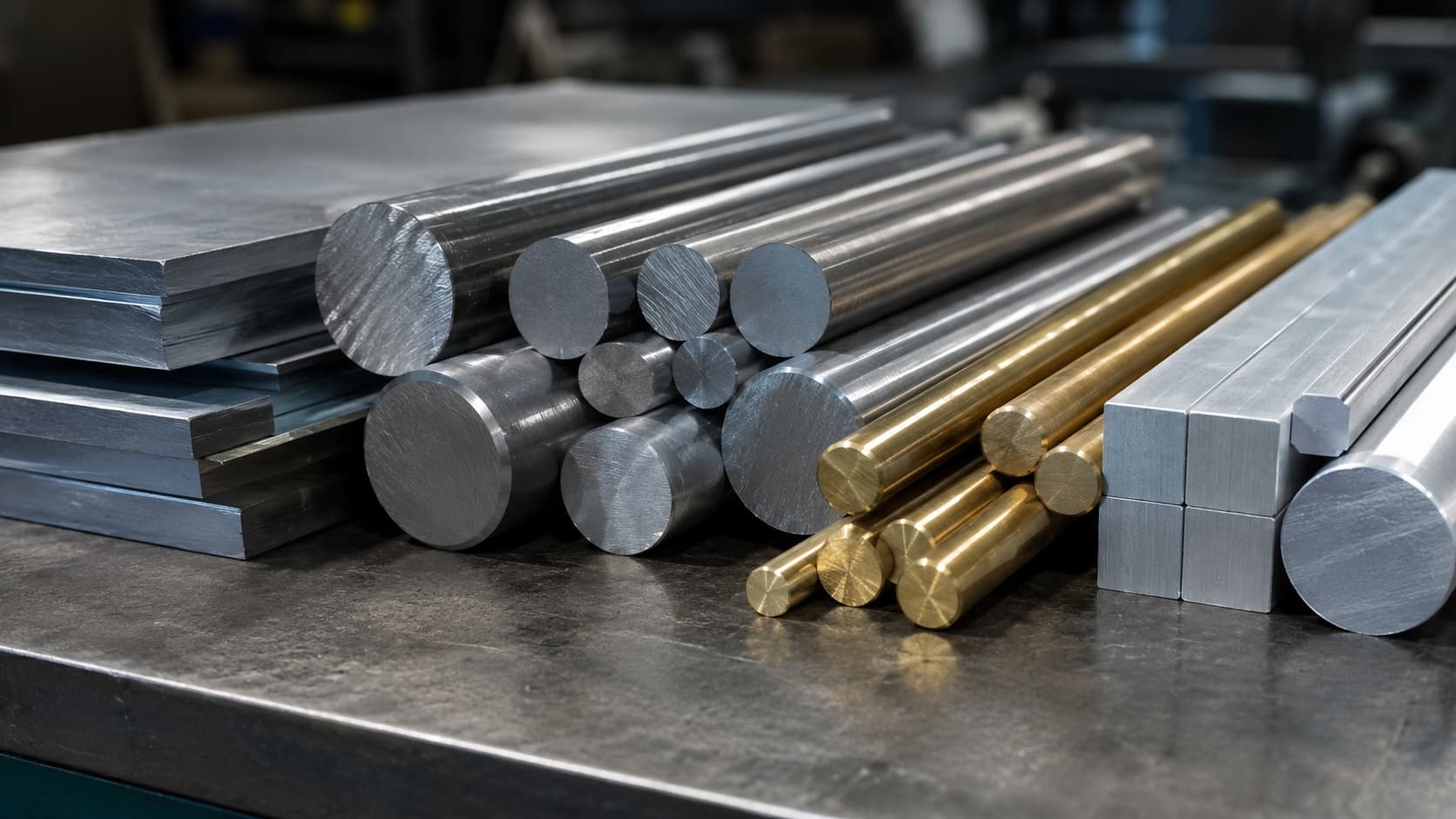
Choosing a material is a balance of strength, corrosion resistance, weight, machinability and cost. For the same shape, a different material changes weight, price and ease of making dramatically, so choosing the right material is the starting point of design and quoting. This guide compares the density, traits, machinability and uses of common metals.
Density of common metals
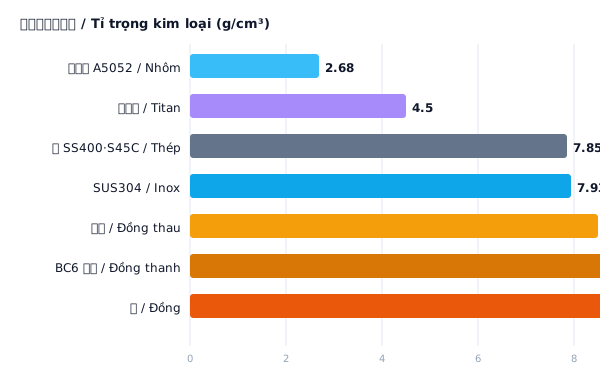
Fig. 1 — Density (g/cm³) guide. Aluminum is about one-third the weight of steel. Since weight = volume × density, density ties directly to the quote (material cost).
Traits · machinability · uses by material
| Material | Density (guide) | Traits | Machinability | Uses |
|---|---|---|---|---|
| SS400 | 7.85 | General structural steel, cheap | Good | Frames, brackets |
| S45C | 7.85 | Carbon structural steel, heat-treatable | Good | Shafts, gears |
| SUS304 | 7.93 | Representative stainless, corrosion ◎, non-magnetic | Hard (gummy) | Food, wet environments |
| SUS303 | 7.93 | Free-cutting stainless | Medium | Small parts, threaded parts |
| A5052 | 2.68 | Light, corrosion-resistant, general aluminum | Good | Sheet metal, jigs, covers |
| A2017 | 2.79 | High-strength aluminum (duralumin) | Good | Light parts needing strength |
| Free-cutting brass C3604 | 8.5 | Very easy to cut, conductive | Excellent | Terminals, valves, high-volume small parts |
※ Densities are typical values. Verify exact figures against the material standard/maker data.
How to choose a material
- Need strength: S45C (heat-treated), A2017.
- Must not rust: SUS304, aluminum (with anodizing).
- Want it light: aluminum (A5052/A2017).
- Cut in volume cheaply: free-cutting brass C3604, SUS303.
- When unsure, pick "the minimum material the function needs" to keep cost down.
Machinability cautions
- SUS304 is gummy and work-hardens → watch tool wear and heat (lower cutting conditions, favor sharpness).
- Aluminum is soft and prone to welding/tearing → sharp edges, high speed, coolant.
- Free-cutting materials (C3604, SUS303) cut easily thanks to additives, favoring high-volume small parts.
Common mistakes
- Not accounting for density and mis-estimating weight and material cost.
- Cutting SUS with steel-like conditions and burning tools.
- Choosing steel for a corrosion-critical part and having it rust.
- Specifying a steel surface treatment for aluminum.
Frequently asked questions (FAQ)
Q. What's the lightest practical metal?
A. Usually aluminum (density 2.7). Magnesium is lighter (1.74) but needs careful handling.
Q. SUS304 vs. SUS303? A. 303 adds free-cutting properties. Easier to cut, but 304 has slightly better corrosion resistance.
Q. How do I calculate weight? A. Volume × density. For round bar: π×(D/2)²×L×density. Used to compute material cost in a quote.
Q. How to get strength and lightness? A. High-strength aluminum like A2017 (duralumin). Choose by application.
Q. Material choice to cut cost? A. Avoid over-quality; pick the material/grade the function needs. Free-cutting materials also cut machining cost.
Summary
Choose metals by balancing density, strength, corrosion resistance, machinability and cost. Weight = volume × density ties directly to the quote; SUS resists corrosion but is gummy, aluminum is light but prone to welding, and free-cutting materials suit volume — picking a "just enough" material for the function is the rule.
Sontis Management manages materials, density and unit prices and computes material cost from weight in your quotes. Try it on the free plan.
Manage quotes & inventory — free, starting today.
No credit card · 5 minutes to start. Management software for machine shops.
Start for free