Grinding Basics【Surface, Cylindrical and Internal Grinding, Explained】
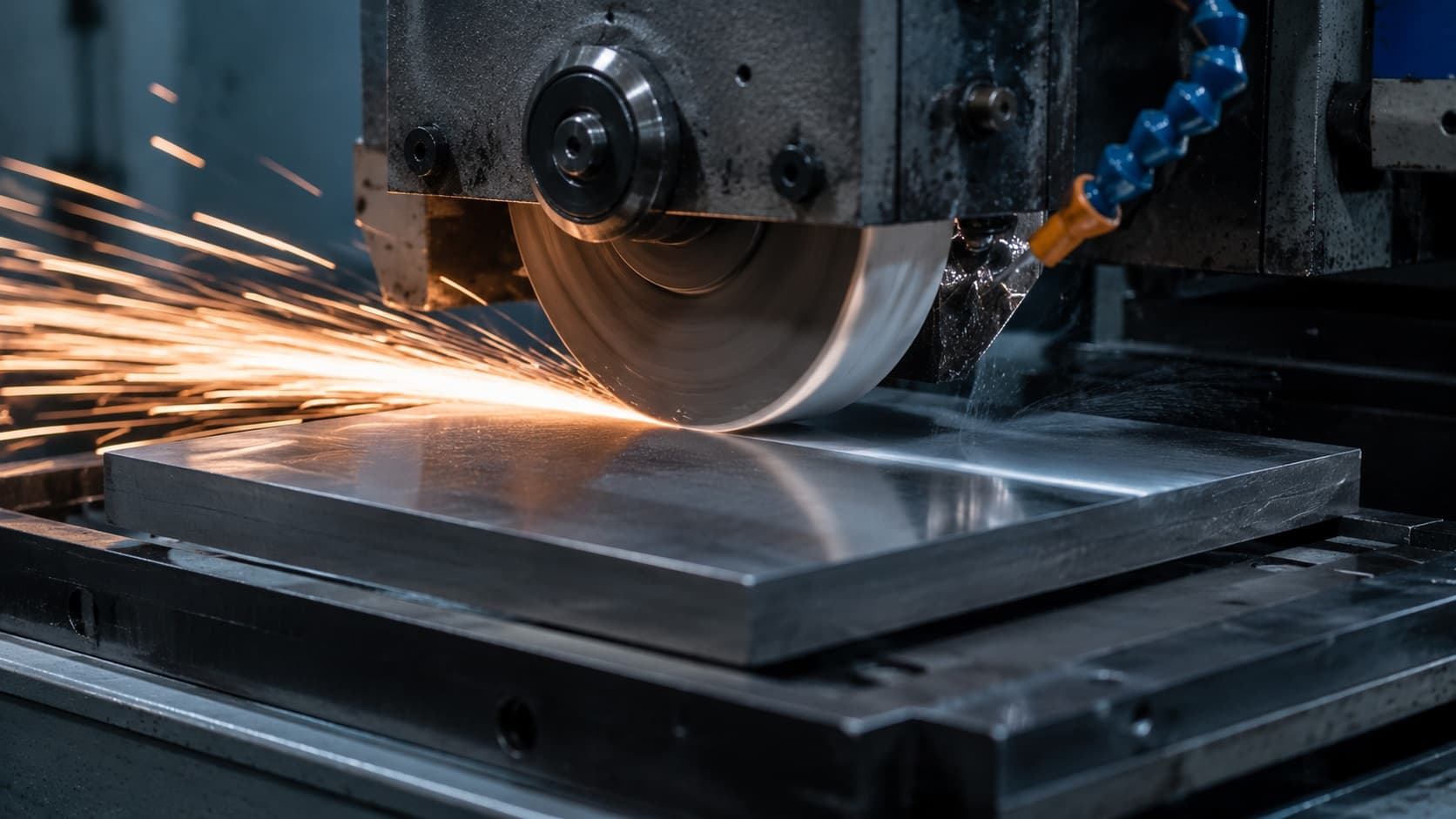
Grinding is a finishing process that removes tiny amounts with a high-speed grinding wheel to achieve high accuracy and a fine finish. It targets dimensional accuracy (IT5–IT7) and Ra 0.2–0.8μm that cutting can't reach, and its biggest strength is that it can machine even hardened material. This guide covers grinding types, wheels, why it's accurate, why it finishes after heat treatment, and cautions — with a diagram.
What grinding is
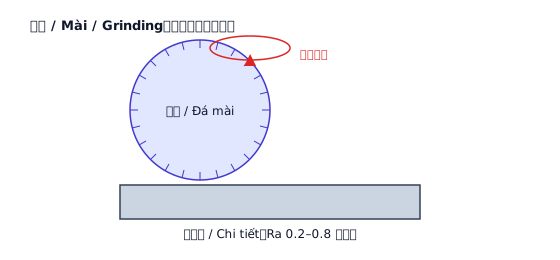
Fig. 1 — The countless abrasive grains are tiny cutting edges. Each grain on the fast-spinning wheel acts as a small cutting edge, shaving off very thin layers. Because the depth of cut is tiny, it produces high accuracy and a fine finish.
Types of grinding
| Type | Target | Example |
|---|---|---|
| Surface grinding | Flat faces | Block/die flats |
| Cylindrical grinding | OD (round parts) | Shafts, pins |
| Internal grinding | Bore ID | Bushing/ring bores |
| Centerless grinding | OD (no centers) | High-volume small pins |
Why it achieves high accuracy and fine finish
- The depth of cut per pass is minute, limiting elastic deformation and heat effects.
- Many grains act at once, giving a fine finished surface.
- A rigid grinder and precise feed keep dimensional variation small.
Why it's used to finish after heat treatment
Material hardened by quenching can't be cut with ordinary tools. Grinding works even after hardening, so the standard order is "rough machining → heat treatment → grind to finish." Leave the heat-treatment distortion as a grinding allowance.
Grinding burn · cautions
- Grinding burn: heat alters/softens the surface or causes cracks. Caused by too much depth of cut, wheel glazing, or insufficient coolant.
- Fixes: appropriate depth of cut, correct wheel choice, ample coolant, dressing the wheel.
- Choose the wheel by application (grit, bond hardness, porosity). Hard materials often suit a softer bond.
Common mistakes
- Getting greedy with depth of cut and causing grinding burn.
- Grinding to finish size before heat treatment and distorting.
- Neglecting wheel choice/dressing, roughening or burning the surface.
- Leaving no grinding allowance and being unable to clean up after heat treatment.
Frequently asked questions (FAQ)
Q. How accurate is grinding? A. As a guide, IT5–IT7 and Ra 0.2–0.8μm. Finer is possible with the right conditions.
Q. Cutting or grinding first? A. Cutting (rough/semi-finish) → heat treatment → grinding (finish) is the basic flow.
Q. How do I spot grinding burn? A. Discoloration, micro-cracks, reduced hardness. Check hardness/structure on suspect surfaces.
Q. What's the benefit of centerless grinding? A. No centering needed; high-throughput production of small parts.
Q. How do I choose a wheel? A. Choose grit/bond hardness/abrasive by material, finish and allowance. Start from the maker's recommendation.
Summary
Grinding removes tiny amounts with a wheel, achieving accuracy and finish that cutting can't reach, and its strength is machining hardened material. To avoid grinding burn, manage depth of cut, wheel, coolant and dressing; and leave a grinding allowance for the finishing step after heat treatment.
Sontis Management keeps machining steps, conditions and inspection standards together with materials, quotes and orders. Try it on the free plan.
Manage quotes & inventory — free, starting today.
No credit card · 5 minutes to start. Management software for machine shops.
Start for free