Surface Treatment Basics【Plating vs. Anodizing vs. Black Oxide, Explained】
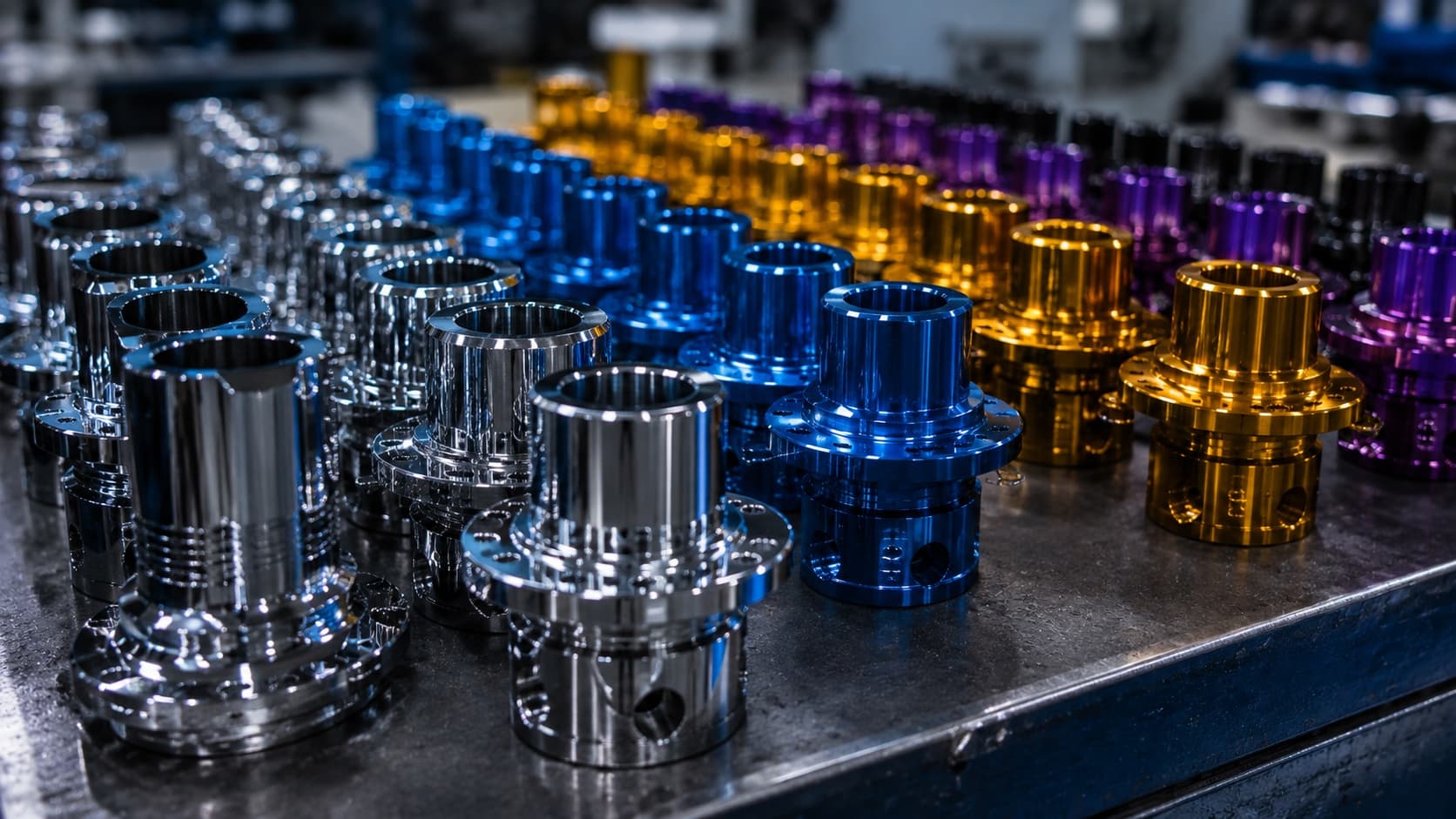
Surface treatment builds a coating on a part's surface to give properties such as corrosion resistance, wear resistance, appearance and conductivity/insulation. Because each treatment changes the thickness (dimension), at mating features you must account for coating thickness when specifying sizes. This guide covers the purpose, thickness, base materials and cautions of the main treatments — with a diagram.
Main surface treatments and their purpose
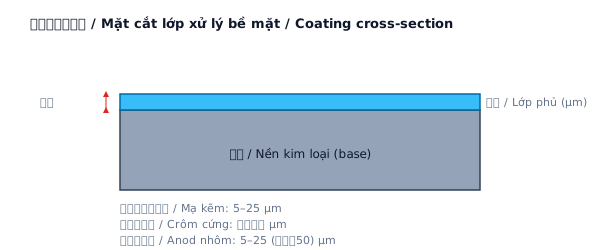
Fig. 1 — The coating sits on the base metal. The dimension grows by the coating thickness (holes get smaller, shafts get bigger).
| Treatment | Main purpose | Base material examples |
|---|---|---|
| Electro-galvanizing (zinc) | Corrosion resistance (cheap) | Iron/steel |
| Hard chrome plating | Wear resistance, hardness | Iron/steel |
| Electroless nickel | Corrosion resistance + uniform thickness | Iron, aluminum, etc. |
| Anodizing | Corrosion resistance, insulation, coloring | Aluminum |
| Black oxide (magnetite) | Mild corrosion resistance, black look | Iron/steel |
| Painting | Appearance, corrosion resistance | Various |
Coating thickness and its effect on dimensions
- Electro-galvanizing: about 5–25μm.
- Hard chrome: a few to tens of μm (thicker on demand).
- Anodizing: 5–25μm (hard anodizing up to ~50μm). The film grows inward and outward, so watch the dimensional increase.
- Black oxide: 1–2μm, so thin that the dimensional change is negligible.
- For mating/threaded features, allow for the thickness, or handle it with post-machining/masking.
Base materials and how to choose
- Iron/steel: zinc plating or black oxide for corrosion resistance; hard chrome for wear.
- Aluminum: anodizing is standard (corrosion resistance, insulation, coloring).
- When uniform thickness matters, use electroless nickel (it covers complex shapes and internal surfaces evenly).
- Choose by purpose (corrosion/wear/appearance/conductivity) and material.
Cautions
- Hydrogen embrittlement: plating high-strength steel can absorb hydrogen and cause delayed cracking. Counter it with baking (heating to expel hydrogen).
- Masking: cover faces you don't want treated (mating and datum surfaces) beforehand.
- Pre-treatment: degreasing, pickling, etc., determine adhesion.
- Black oxide is weakly corrosion-resistant and assumes use with a rust-preventive oil.
Common mistakes
- Not allowing for coating thickness at mating features, so parts won't assemble or are loose.
- Mistaking black oxide for strong corrosion resistance (oil is required).
- Skipping baking on high-strength steel and getting delayed cracks.
- Specifying an iron treatment for aluminum (material–treatment mismatch).
Frequently asked questions (FAQ)
Q. What's the cheapest corrosion protection? A. Usually zinc plating or black oxide. Choose by requirement (appearance, durability).
Q. Can you anodize steel? A. No. Anodizing applies to aluminum and similar materials only.
Q. How much does thickness change the dimension? A. It depends on the treatment. Even microns matter for fits, so specify and check on the drawing.
Q. Does black oxide throw off dimensions? A. At 1–2μm it's negligible for most applications.
Q. How do I prevent hydrogen embrittlement? A. Bake (heat to expel hydrogen) after plating. Especially important for high-strength steel.
Summary
Choose surface treatment by purpose (corrosion/wear/appearance/insulation) and base material, and the key machining point is that coating thickness affects the dimension. Allow for thickness at mating/threaded features, bake high-strength steel, and mask surfaces that shouldn't be treated.
Sontis Management centralizes materials, surface treatments and machining conditions and links quoting, orders and inspection. Try it on the free plan.
Manage quotes & inventory — free, starting today.
No credit card · 5 minutes to start. Management software for machine shops.
Start for free